Sampling Methods
How to pick the right people for your study
Why Sampling?
You can't survey everyone! So you pick a sample (small group) to represent the population (everyone).
Good sample = Results you can trust Bad sample = Misleading conclusions
4 Main Sampling Methods
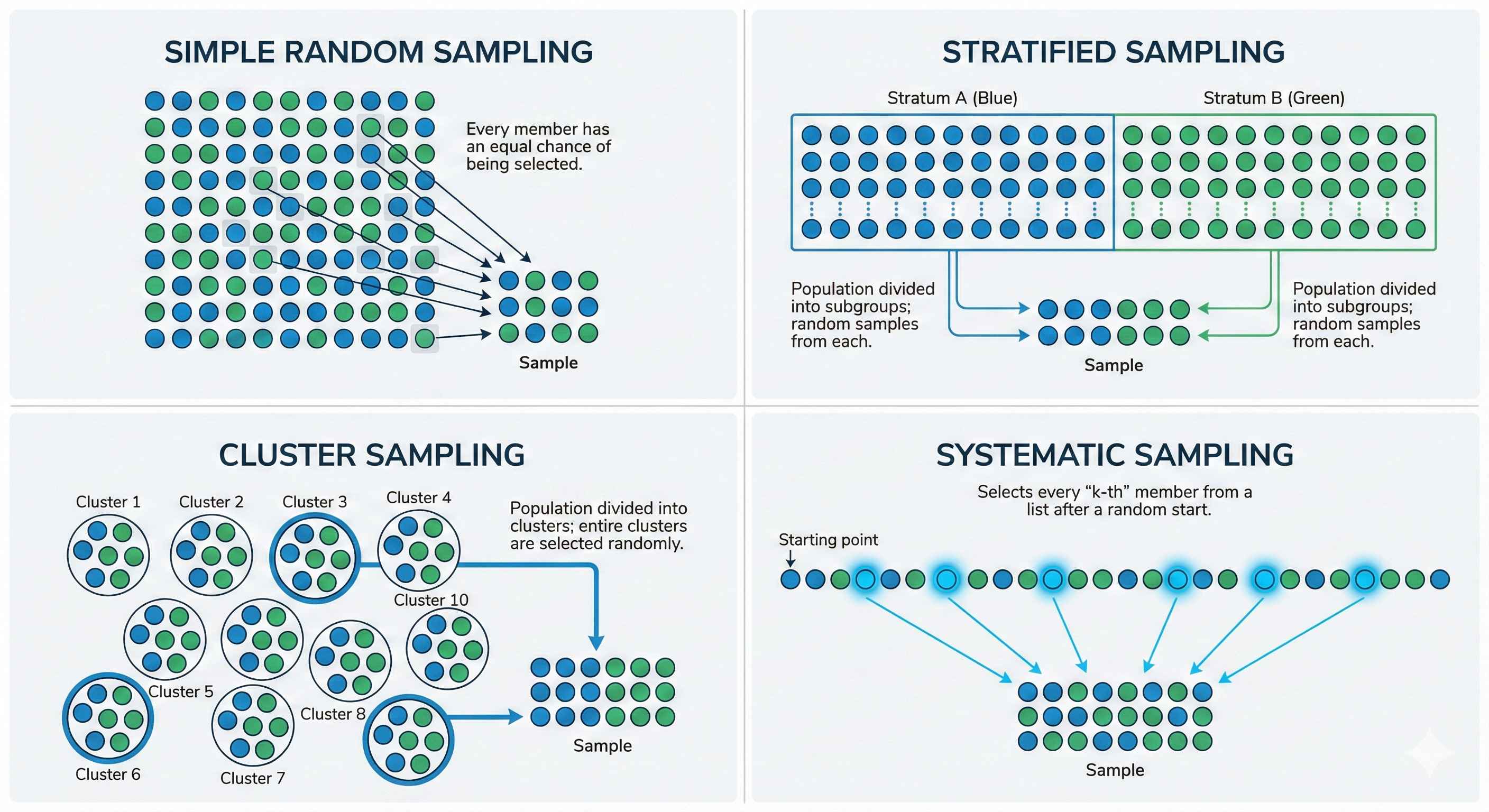
| Method | How It Works | Best For |
|---|---|---|
| Simple Random | Everyone has equal chance | General surveys |
| Stratified | Divide into groups, sample each | Ensuring diversity |
| Cluster | Pick random groups, survey all in them | Geographic studies |
| Systematic | Every nth person | Production lines |
1. Simple Random Sampling
How: Use random number generator to pick people
Example: Pick 100 random customers from 10,000
Good: Unbiased, simple Bad: Might miss small groups
2. Stratified Sampling
How: Split population into groups → sample from each group
Example: Want 100 people? Pick 50 men + 50 women (not random 100)
Good: Guarantees representation Bad: Need to know group sizes beforehand
3. Cluster Sampling
How: Randomly pick some groups → survey EVERYONE in those groups
Example: Pick 5 random cities → survey all residents in those cities
Good: Cheaper, easier logistics Bad: Less precise than other methods
4. Systematic Sampling
How: Pick every nth person from a list
Example: Every 10th customer entering the store
Good: Easy to implement Bad: Can miss patterns (if list has hidden order)
Beware: Sampling Bias!
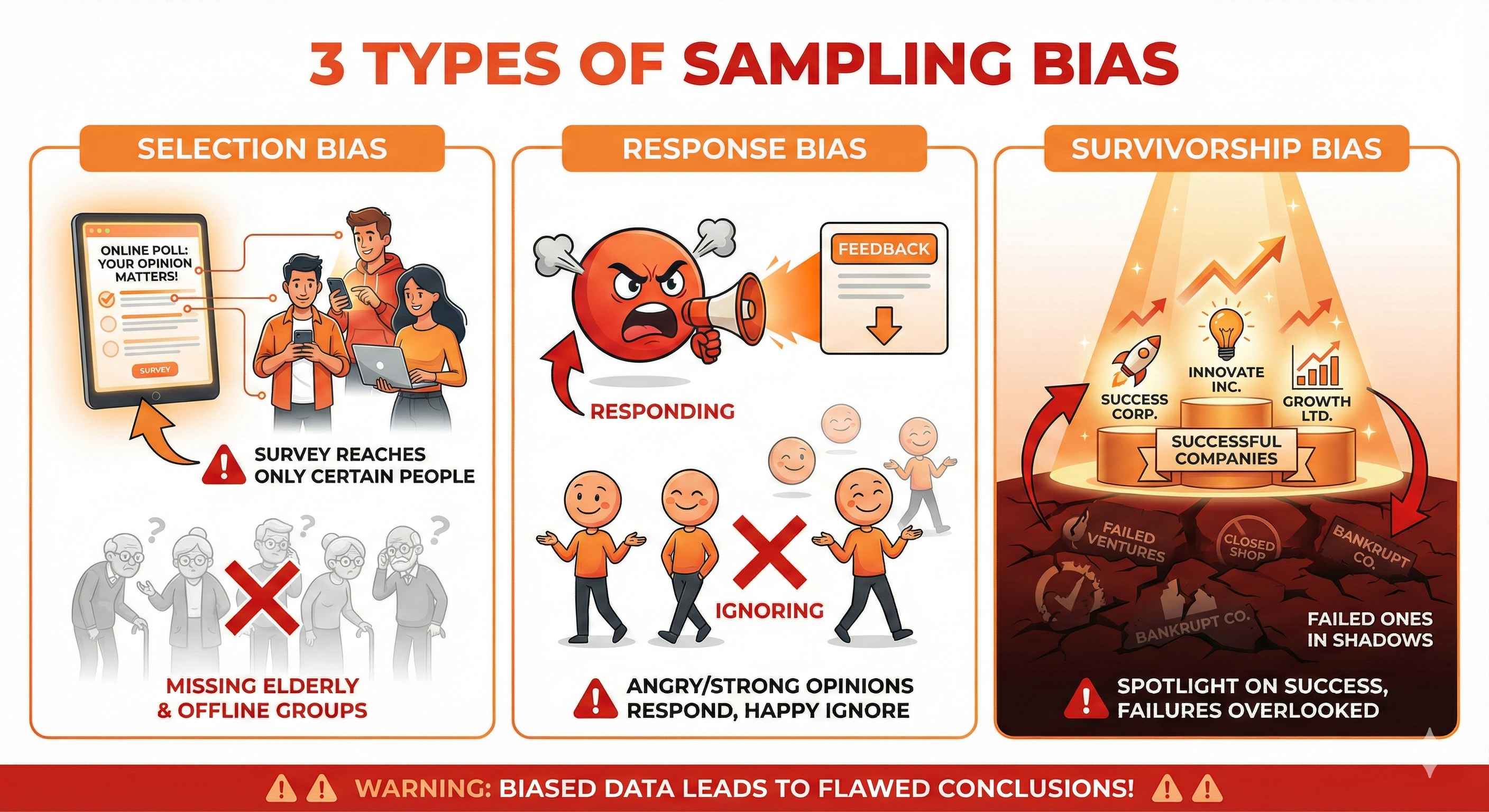
| Bias Type | What Happens | Example |
|---|---|---|
| Selection Bias | Some people more likely to be picked | Online survey misses elderly |
| Response Bias | Only certain people respond | Angry customers more likely to reply |
| Survivorship Bias | Only see successes | Studying successful startups only |
Fix: Proper randomization + high response rate!
How Big Should Your Sample Be?
Rule of thumb:
- Minimum: 30 (for statistics to work)
- Good: 100+ for reliable results
- Better: Use sample size calculator
More samples = More accurate, but more expensive
Quick Practice
You want to survey 100 students from a school of 1000:
- Simple Random: Random number generator picks 100
- Stratified: 25 from each year (Freshman, Sophomore, Junior, Senior)
- Cluster: Pick 2 random classrooms, survey everyone
Tip: Bad sampling ruins even the best analysis. Get this right first!